Feather Guard is a Leading Supplier of bird control drones, laser deterrents, sonic-ultrasonic repellents and industrial bird netting, protecting large sites across Gujarat and India since 1972.
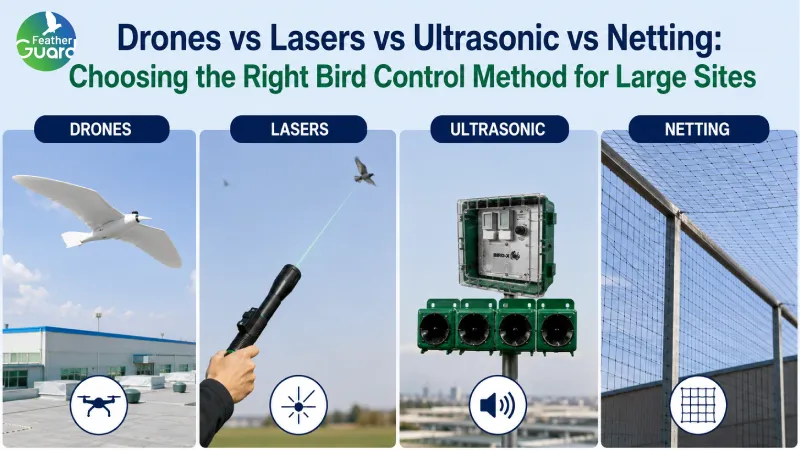
A 200-acre solar park, an airport apron, a port terminal, a food processing complex — sites like these cannot be netted end to end, and a single sound device will not cover them. Yet bird pressure on large sites carries real costs: contaminated product, corroded panels, bird-strike risk, blocked drains and failed audits. The question is not whether to control birds, but which method actually fits the scale. This guide compares the four leading options — including the Bird Control Drone System — so the choice is based on how each one performs, not on what is easiest to sell.
| Method | How it works | Best fit | Main limitation |
|---|---|---|---|
| Bird Control Drone | Remote-controlled robotic falcon mimics a real predator in flight | Open land, airports, farms, ports, solar parks | Needs a trained operator; flight time per battery |
| Laser Deterrent | Moving green beam perceived as a physical threat | Roofs, fields, aprons, low-light periods | Reduced contrast in bright midday sun |
| Sonic / Ultrasonic | Predator and distress calls plus ultrasonic discomfort | Warehouses, sheds, canopies, semi-enclosed areas | Ultrasonic alone is weak outdoors; habituation if not rotated |
| Bird Netting | Physical exclusion — birds cannot enter | Buildings, docks, rafters, façades, any defined structure | Cannot cover open land; installation is site-specific |
Birds respond to one threat above all others: a bird of prey. The Bird Control Drone System we supply is a robotic peregrine falcon that replicates the appearance, size, weight and flight behaviour of the real predator — 850 g, 112 cm wingspan, speeds up to 75 km/h and stable in winds gusting to 28 knots. Nuisance birds read it as a genuine hunt and vacate the area immediately.
Why it suits large sites:
Best for airports, ports, agriculture, solar parks, landfills and industrial campuses with wide open perimeters.
A handheld or automated laser projects a green beam that birds perceive as a solid object approaching. It is silent, chemical-free and effective at distances beyond 2,500 metres, making it ideal for rooftops, fields and aprons — particularly at dawn, dusk and in overcast conditions when birds are most active. In strong midday sun the contrast drops, so lasers work best as a scheduled or supporting layer rather than the sole method on open land.
Sonic systems play digitally recorded predator and distress calls within the range birds hear best; ultrasonic adds acoustic discomfort that performs well inside enclosed or semi-enclosed spaces where sound reflects. Multi-speaker units can cover several acres of sound, but ultrasonic alone in open outdoor areas delivers weak results, and any fixed sound needs regular rotation to prevent habituation. Strongest fit: warehouses, factory sheds, loading bays, canopies and hangars.
Netting does not deter — it excludes. Correctly installed UV-stabilised netting removes the possibility of entry altogether, which is why it remains the standard for food and pharma facilities, docks, rafters and building façades where zero tolerance applies. Its limitation is scope: it protects defined structures, not open ground.
Ask three questions:
In practice, the most reliable large-site programmes combine methods: netting on buildings, drone patrols over open areas, lasers at dawn and dusk, and sonic units in covered yards.
Feather Guard, supplies and installs all four methods — bird control drones, Agrilaser and automated laser deterrents, sonic-ultrasonic systems and industrial netting — so our recommendation is based on your site, not on a single product. With ISO, HACCP and GMP certifications, offices in Ahmedabad, Surat, Vadodara and Gandhidham, and trained technicians experienced across airports, food, pharma, warehousing and agriculture, we survey your site, assess bird species and pressure, and design an integrated, humane programme that holds up over time.
No single bird control method fits every large site. Netting guarantees exclusion but only on structures; sonic and ultrasonic systems work where sound is contained; lasers deliver silent long-range dispersal with light-dependent performance; and the bird control drone brings the one threat birds never learn to ignore — a predator in flight — to open ground that nothing else can cover. The right answer is usually a combination, matched to structure, scale and tolerance. Feather Guard brings every option under one roof, along with the field experience to combine them correctly, so your site stays protected without harming a single bird.
Managing bird pressure on a large site? Request a free site assessment and we will recommend the right mix of drone, laser, sonic and netting solutions. Call us: +91 8448444801 or Email: care@featherguard.co.in — and let Feather Guard design a bird control programme that fits your scale.
CEO, Feather Guard (by Bitco Integrated Pest Management LLP), Ahmedabad
A results-driven leader, Mitesh Agarwal spearheads Feather Guard as one of Gujarat's most trusted bird-proofing and pest management companies. Under his leadership, the firm achieved IPCA, HACCP, and ISO certifications and won the prestigious Gujarat Icons 2024 Award by the Times of India Group. His digital transformation vision, including 100% ERP implementation, has driven exponential growth delivering humane, technology-backed bird control solutions across residential, commercial, and industrial sectors.
A Bird Control Drone System is a remote-controlled device that mimics the flight of a predator, specifically a peregrine falcon, to deter nuisance birds. It effectively covers open land and aligns with the natural instincts of birds, prompting them to vacate the area due to the perceived threat.
Drones are ideal for open areas where netting cannot be applied, offering flexibility and coverage across large sites. In contrast, netting provides guaranteed exclusion in defined structures but is not suitable for vast, open settings.
Yes, bird control drones are particularly effective in airports due to their ability to cover large, open spaces and reduce the risk of bird strikes. Their mimicry of predator flight helps keep flight paths clear of nuisance birds.
The main limitations include the need for a trained operator to control the drone and a flight time of around 20 minutes per battery. This necessitates regular recharging and potential scheduling to ensure consistent bird control.
To determine the best method, consider whether the issue is in an open area or a structure, the scale of your site, and your tolerance for bird presence. Often, a combination of drones, lasers, sonic systems, and netting is the most effective solution.

Copyright © All Rights Reserved To Feather Guard By Bitco | Designed & Developed By Clients Now SEO Agency | Website Updated On : 03 September 2026